

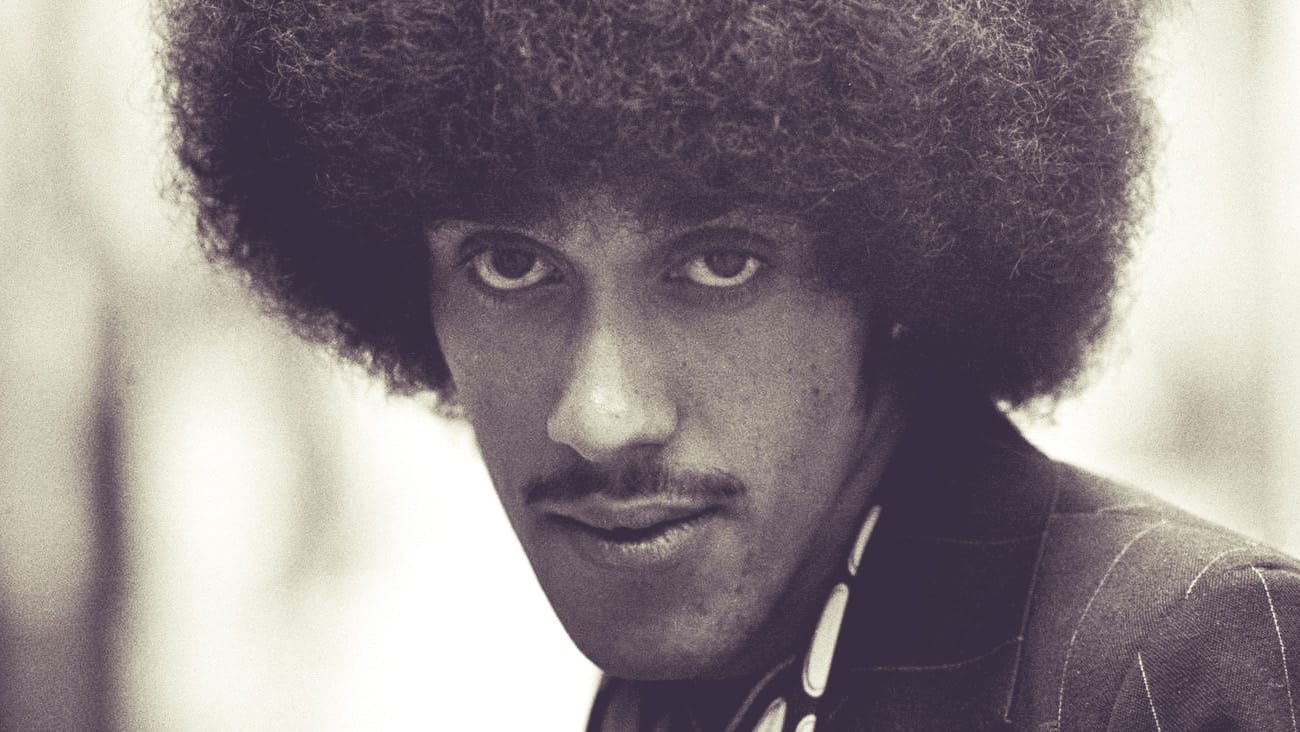
Phil Lynott stands as one of the greatest vocalists and bassists in the history of hard rock, passing away at the tender age of just 36 on 4 January 1986 [cite: wikipedia].
He was the first black Irish hard rock musician to achieve global success, serving as the frontman, primary songwriter, bassist, and lead vocalist of Thin Lizzy.
During 1969 and 1983, Thin Lizzy delivered 12 studio albums alongside an array of iconic hits. Including “The Boys Are Back In Town”, “Whiskey In The Jar”, and “Jailbreak”
Looking back at the 1970s, the rock music landscape was overwhelmingly dominated by white male artists. If one were to recall black rock stars from that epoch, apart from the guitar deity Jimi Hendrix, very few names would readily come to mind. Contrasting sharply with the extensive, almost endless list of white rock icons. Phil Lynott became a striking visual and cultural symbol of a black rock star, despite being of mixed heritage, born to a white Irish mother and a black Guyanese father.


Cultural Identity and the Rise of Thin Lizzy
Thin Lizzy enjoyed immense success throughout their active years. Having been raised in Dublin, Phil deeply absorbed the local street culture, folk music, traditional busking melodies, ancient poetic ballads, and oral folklore, seamlessly blending them with his distinctive, non-aggressive, soul-infused vocal delivery. These elements rendered his artistry entirely unparalleled. For instance, their hit “Whiskey In The Jar” was an adaptation of an ancient Irish traditional folk song, while “Black Rose (A Rock Legend)” heavily referenced Cú Chulainn, one of the most pivotal mythological demigods in ancient Celtic lore.

He was a rock star unlike any other of his generation. He once famously remarked about his own identity:
” I’d like Ireland to become one nation, but then, we are. We seem to be all Irish when we’re away from Ireland. When I’m in Ireland, I say I’m from Dublin, when I’m in Dublin, I say I’m from Crumlin. When I’m in Crumlin, I say I’m from Leighlin Road, and when I’m in Leighlin Road, I say I’m a Lynott “
While it sounded like a witty jest, the phrase deeply reflected Phil’s profoundly complex identity. He was simultaneously an Irishman and an outsider; a black child in the “white” working-class district of Crumlin who become a black rocker in a predominantly white rock world, and a rock star in a nation where rock music was often perceived as a British or American cultural import rather than something natively Irish.
Internal Fractures and the Dissolution of the Collective
However, Thin Lizzy eventually reached their twilight and final studio album. Thunder and Lightningmight not have been their finest artistic hour, but it remained a highly commendable rock record that out-performed several of its predecessors commercially. Yet, internal dynamics within the band were rapidly deteriorating. Prior to recording, drummer Brian Downey was forced to temporarily step away to resolve a legal altercation in Denmark. Scott Gorham had to withdraw from touring due to severe drug addiction, having infamously collapsed on stage before being flown home. By late 1982, guitarist Snowy White resigned from the band, thoroughly exhausted by Phil’s escalating substance abuse, which routinely derailed their professional schedule, compounded by suspicions over whether Phil remained fully committed to the band due to his concurrent solo projects.
Following the conclusion of their final tour, Thin Lizzy disbanded, splintering in separate directions due to friction over their creative vision, operational methods, and personal crises. Immediately after the dissolution, Phil embarked on a brief tour under the moniker “The Three Musketeers” alongside John Sykes and Brian Downey. This project subsequently evolved into the band Grand Slam, recruiting Mark Stanway on keyboards and Donal “Doish” Nagle on guitar.
This venture, however, proved short-lived. Brian Downey soon departed, followed by John Sykes, who accepted an invitation from David Coverdale to join Whitesnake. They were replaced by drummer Robbie Brennan and guitarist Laurence Archer. Seeking to escape the monolithic shadow of Thin Lizzy, the band experimented with an updated sound infusing elements of funk and subtle hip-hop textures, attempting to align Phil’s voice with the contemporary landscapes of post-punk, new wave, and new romanticism. Regrettably, these efforts met with minimal commercial success.
The Changing Era
Furthermore, by 1984–1985, the broader rock ecosystem was undergoing a seismic shift, dominated by the visual hegemony of MTV and the meteoric rise of glam metal. Phil, much like many of his 1970s contemporaries, increasingly felt like an anachronism in this new musical era. While he retained significant cultural capital in the UK and Ireland. Remaining a beloved legend capable of generating substantial ticket sales. It was insufficient to convince record labels to gamble on an aging rock star whose volatile struggle with drug dependency made him fundamentally unreliable. Consequently, Grand Slam disbanded by the end of 1984.
Compounding his professional woes, Phil’s marriage to Caroline Crowther collapsed, culminating in their divorce in 1984, with his two daughters remaining in their mother’s custody. Left without a band or a family unit, Phil sank deeper into severe heroin addiction. Despite this downward spiral, a momentary resurgence arrived when he reunited with Gary Moore for the single “Out In The Fields” from 1985 album Run for Cover. Phil was featured prominently in the accompanying music video, and the commercial success of the single prompted Polydor Records to offer him a solo recording contract complete with a $100,000 advance.
![Gary Moore feat. Phil Lynott - Out In The Fields [HD]](https://i.ytimg.com/vi/VbUiKj9DML4/hqdefault.jpg)
Live Aid
Around the same period, Bob Geldof and Midge Ure, both counted among Phil’s close friends, were organising the historic Live Aid benefit concert. Scheduled for 13 July 1985 at Wembley Stadium in London. Speculation was rife that Thin Lizzy would be approached to reform for the event, given Phil’s status as a towering icon of Irish rock who had actively championed numerous Irish acts, including Geldof’s own band, The Boomtown Rats. Furthermore, Ure himself had briefly served as a touring guitarist for Thin Lizzy.
However, years after Phil’s passing, Midge Ure candidly disclosed that neither he nor Geldof had ever seriously considered inviting Thin Lizzy to perform at Live Aid. Ure recalled: “If he had been fit, it would have been like Queen. Can you imagine ‘The Boys Are Back in Town’ at Wembley? Can you see it? But it never entered our minds, even though we were both good friends of his. I think he must have felt betrayed. I think if we had asked them to do that gig, Lizzy would have reformed.” [Cite: Cowboy Song: The Authorized Biography of Phillip Lynott, Book by Graeme Thomson, 2016]
Darren Wharton, Thin Lizzy’s former keyboardist, echoed this somber sentiment: “It was a tragic decision because it might have been the catalyst to help Phil overcome his drug problems and recover. I believe he was physically capable of performing that day. I don’t think Phil ever forgave Bob and Midge for that omission.”
Regrettably, history took a different path. Live Aid became a monumental celebration of classic rock, orchestrating a historic renaissance for Queen, catapulting Status Quo back into the limelight, and renewing intense media spotlight on veteran hard rock outfits like Black Sabbath and Led Zeppelin who reunited their classic lineups. Yet, Thin Lizzy and Phil Lynott received no such invitation. The very pioneer who had blazed the trail for Irish rock music found himself painfully left behind.
The Final Days
While Phil’s physical condition during this period was undeniably frail. His live performances tragically betraying the image of an exhausted, broken man. Many commentators argue that being systematically overlooked for Live Aid severely exacerbated his psychological decline. Though he pushed himself to record the single “Nineteen,” his health continued to precipitously decay. Eventually, Charlie McClellan, one of Phil’s studio collaborators, took the initiative to inform Phil’s mother of her son’s critical condition, prompting her to move into his residence to care for him.

When his old bandmate Scott Gorham visited, he described a heartbreaking scene: “He had put on weight, was breathing with a heavy rasp, yet when he spoke of the future, I genuinely believed there was a glimmer of hope that he could return to his former self. We spoke about reforming the band, wished each other a Merry Christmas, and promised to catch up properly very soon.”
Tragically, that conversation marked the final time Scott would see his friend alive. On 25 December 1985, Phil collapsed at his home. His mother immediately contacted his ex-wife, Caroline, and rushed him to the hospital. Although he briefly regained consciousness to speak with his mother, he ultimately passed away on 4 January 1986, at the age of just 36.
In loving Memories
Phil Lynott died decades before the rock world would fully embrace genuine racial diversity. Yet, the enduring image of the black Dubliner standing tall with his bass guitar, singing in that unmistakable Irish cadence, and penning anthems for the marginalised, remains one of the most uniquely iconic portraits in the annals of hard rock.
Perhaps the greatest tragedy lies in the fact that the music world only belatedly realised that this black rock star from Dublin who wrote with the profound heart of a street poet was entirely irreplaceable. In the end, the world he helped shape ultimately left him behind in the final hours of his far-too-brief life.