
“Addicted to Love” is a song by Robert Palmer released in 1986. It is the third song on album Riptide (1985) and was released as its third single.
The end of 2025 marked the final chapter for MTV, which had been broadcasting since 1981. Once one of the most influential forces in the music industry, it eventually had to come to an end, following the natural cycle of all things; nothing lasts forever.
During the 1980s and 90s, MTV was at the height of its power. Record labels splashed out enormous sums on music videos, often spending hundreds of thousands or even millions of dollars. For instance, Michael Jackson’s “Scream” cost a staggering $7 million, while Guns N’ Roses spent nearly $5 million on “Estranged.” These days, you’d be hard-pressed to find a band investing that kind of budget into a music video.
However, that era of fierce competition left us with some truly unforgettable visuals that endure even though MTV is no longer with us. Many of these videos remain etched in our collective memory. One such standout is “Addicted to Love,” a track from the 1985 album Riptide, which was Robert Palmer’s eighth studio release.
Robert Palmer
Before his solo success, Robert Palmer served as the lead singer for several groups, most notably Vinegar Joe in the early 1970s. He eventually launched his solo career with the album Sneakin’ Sally Through the Alley in 1974. Along the way, he built a reputation not just as a talented vocalist, but also as a man with an impeccable sense of style.
While his albums were generally well-received by critics, he hadn’t quite reached “superstar” status with major chart-toppers until 1984. That year, he was invited to provide lead vocals for a cover of T.Rex’s “Get It On (Bang a Gong).” This project evolved into the “side-project” band The Power Station, featuring Andy Taylor and John Taylor from Duran Duran, along with Chic’s drummer Tony Thompson. The group was produced by Bernard Edwards, also of Chic fame.
The Power Station was a significant success; their first single, “Some Like It Hot,” climbed to number 6 on the Billboard Hot 100. However, the band only released one album before going their separate ways, as is often the case with such “interim” projects.
Robert then returned to his solo career for his eighth album, Riptide. He didn’t go it alone, though; he invited Bernard Edwards to produce and Tony Thompson to play drums. Andy Taylor also contributed guitar work to one specific track: “Addicted to Love.”
Addicted to Love
Initially, Riptide saw a somewhat lukewarm response. The first two singles, “Discipline of Love” and “Riptide,” achieved only modest success, and it looked as though Robert’s career might return to its previous steady state. That changed in January 1986 when “Addicted to Love” was released as the third single. It proved to be a massive turning point, hitting number 1 on the Billboard Hot 100 on 3 May 1986. The song’s popularity was so immense that it drove album sales to over 2 million copies in the US alone.
Musically, the song is undeniably brilliant. Its heart lies in its rhythm. Tony Thompson laid down a powerhouse 2/4 foundation, using an open hi-hat on the third beat a key hook of the song. He added weight by playing as far behind the beat as possible. This was complemented by Bernard Edwards’ simple yet incredibly funky bassline, which acted as both a main riff and a sophisticated driving force.
Having Tony on drums was vital; he famously bridged the gap between rock, funk, and pop. Tony had a knack for creating tight, danceable grooves that made him a standout in the disco era. However, “Addicted to Love” was where he truly showed his range, proving he was a master at blending rock intensity with funk timing.
The unique drum sound was a collaboration between Tony and sound engineer Jason Corsaro. They opened the studio doors to a long balcony and positioned microphones at various intervals along the walkway. This captured the sound at different distances, and when combined with the natural reverb, it created the distinctive drum sound that became a hallmark of the era.
Fun Fact: Bernard and Tony were the rhythm section behind the classic “Good Times” by Chic. That foundation was later used by The Sugarhill Gang for “Rapper’s Delight” in 1979, which became the first hip-hop track to achieve mainstream popularity.
Another core element of the song is the heavy guitar riff provided by Eddie Martinez (who also played on Run-DMC’s pioneering 1984 rap-metal track “Rock Box.”)
The ending features a guitar solo by Andy Taylor, while keyboardist Wally Badarou contributed the beautiful melodies and subtle, fluid sequencer work that underpins the track’s rhythm.
Interestingly, the song was originally recorded as a duet with R&B icon Chaka Khan. However, her management stepped in and blocked the use of her vocals, fearing it would interfere with the marketing plan for her own success following the I Feel For You (1984) album. Nevertheless, Robert gave Chaka credit for the vocal arrangement of the song.
The Music Video
Even a great song can be overlooked without a striking music video to grab the public’s attention.
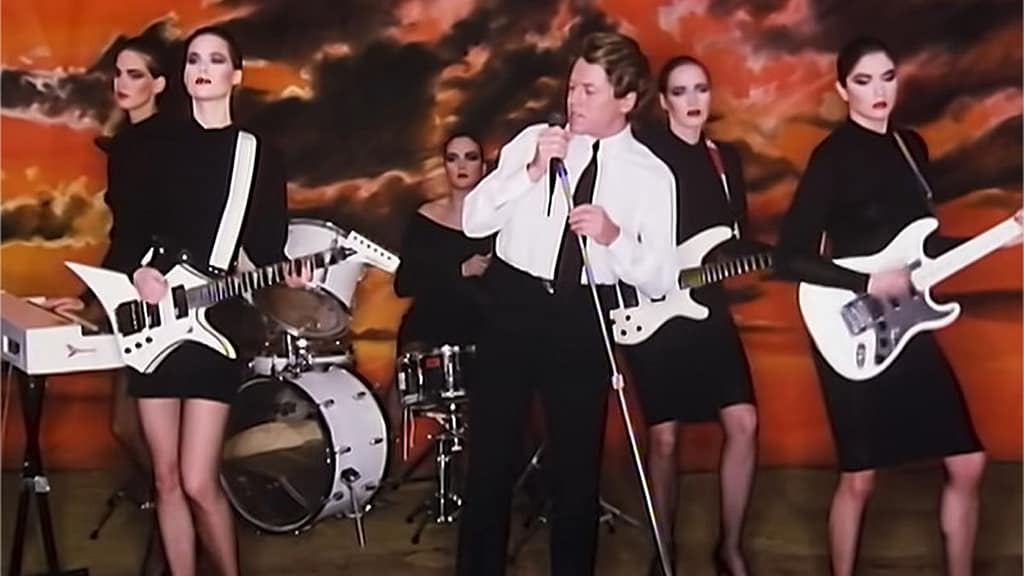
The video for “Addicted to Love” was directed by British fashion photographer Terence Donovan, who put his industry expertise to great use. He chose five models to “play” the instruments instead of the actual musicians. Each model was styled identically: heavy makeup, bright red lips, and slicked-back black hair—an aesthetic inspired by the paintings of Patrick Nagel. Terence instructed the models to mimic a backup band but with stiff, mannequin-like movements.
The five models were:
- Julie Pankhurst (Keyboards)
- Patty Kelly (Guitar)
- Mak Gilchrist (Bass)
- Julia Bolino (Guitar)
- Kathy Davies (Drums)
Robert reused the “model band” concept for “I Didn’t Mean to Turn You On” (also from Riptide) and “Simply Irresistible” from the album Heavy Nova. It remains a landmark moment for the visual influence of the 1980s.
Trivia
At the 1986 MTV Video Music Awards, Van Halen performed the opening bars of “Addicted to Love” before transitioning into their own song, “Best Of Both Worlds.”